
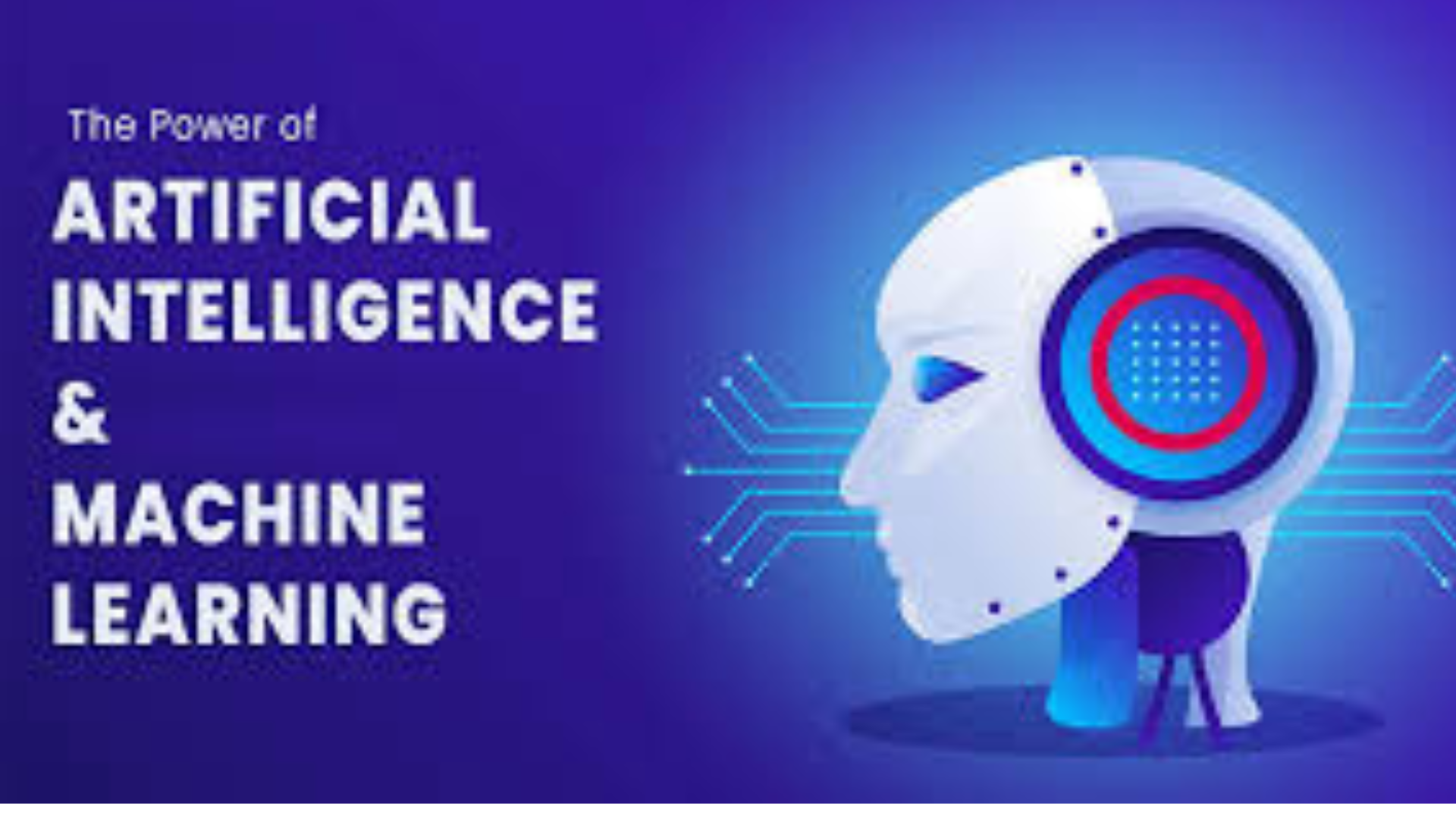
Artificial Intelligence (AI) is a branch of computer science that focuses on creating systems or machines that can perform tasks which normally require human intelligence. These tasks include learning, reasoning, problem-solving, understanding language, and making decisions.
Machine Learning (ML) is a subset of AI that allows computers to learn from data without being explicitly programmed. Instead of following fixed instructions, ML systems improve their performance over time by analyzing patterns and experiences.
Professional Diploma in AI
- Introduction to AI & Python
- Mathematics for AI
- Machine learning
- Deep learning
- Natural language processing (NLP)
- Computer Vision
- Reinforcement Learning
- MLOps & deployment
- Responsible AI
- AI Capstone project
Introduction to AI & Python

Artificial Intelligence (AI) is a technology that enables machines to think, learn, and make decisions like humans. It is used to solve problems, analyze data, and automate tasks.
Key Features of AI
- Learning from data
- Problem-solving
- Decision-making
- Automation
Introduction to Python
Python is a simple and powerful programming language widely used in AI and Machine Learning.
Why Python for AI?
- Easy to learn and use
- Large community support
- Powerful libraries
How AI & Python Work Together
Python is the tool, and AI is the technology.
Python helps developers build AI models easily using its libraries.
Mathematics for AI
Mathematics is the foundation of Artificial Intelligence and Machine Learning. It helps machines understand data, recognize patterns, and make accurate predictions.
Without mathematics, AI models cannot learn or improve.
- Linear Algebra
- Calculus
- Probability
- Statistics
Machine learning
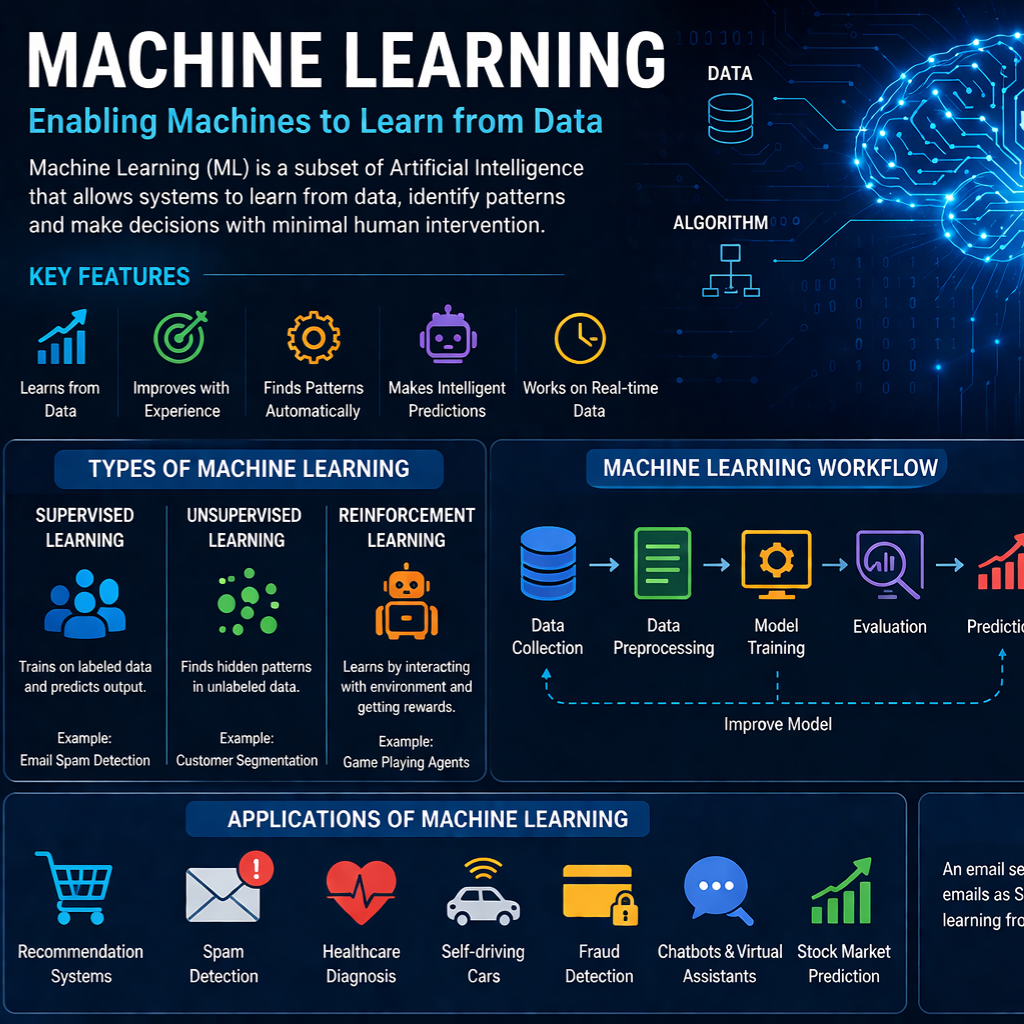
Machine Learning (ML) is a part of Artificial Intelligence that allows computers to learn from data and make decisions without being explicitly programmed.
How Machine Learning Works
Machine Learning follows a basic process:
- Data Collection – Gather data
- Data Processing – Clean and prepare data
- Model Training – Train the algorithm
- Evaluation – Test accuracy
- Prediction – Make decisions
Types of ML
1. Supervised Learning
2. Unsupervised Learning
3. Reinforcement Learning
DEEP LEARNING
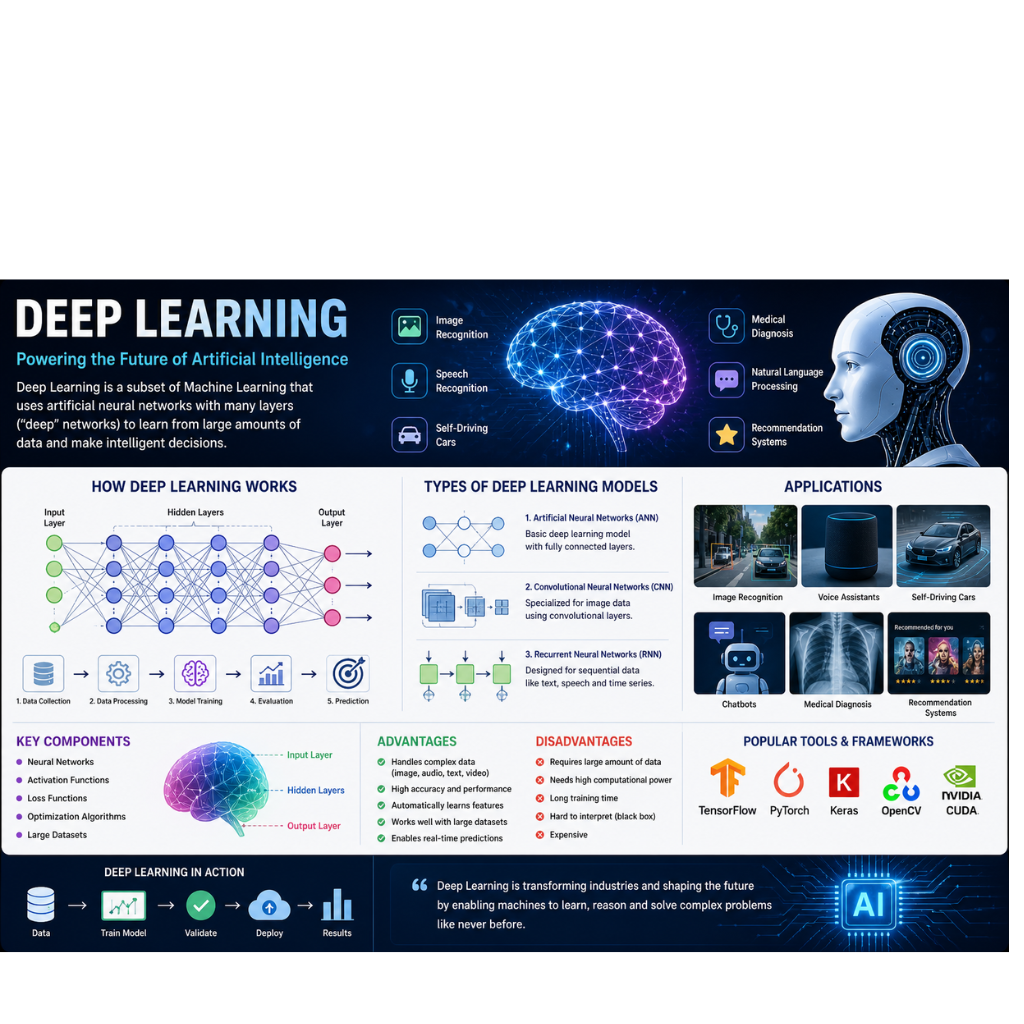
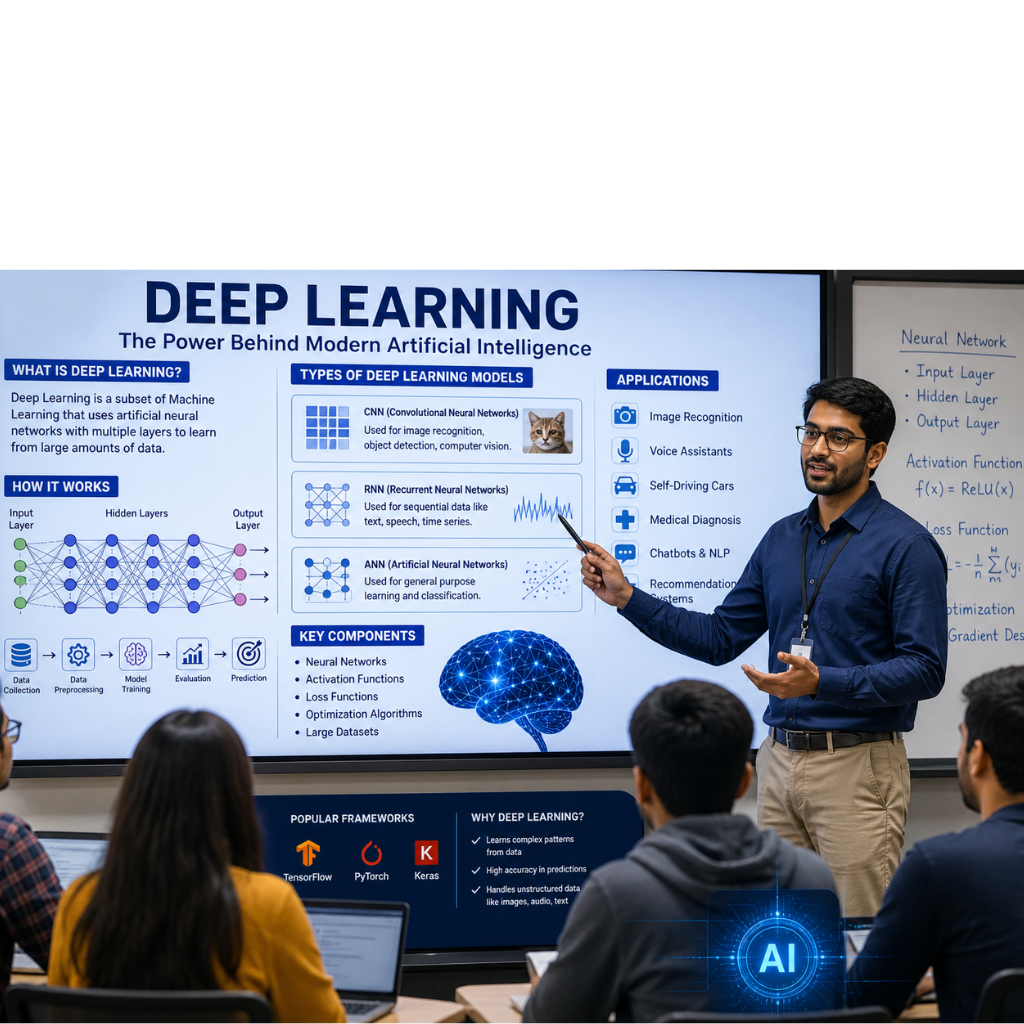
Deep Learning is a subset of Machine Learning that uses artificial neural networks to learn from large amounts of data. It is inspired by how the human brain works.
Types of deep learning models.
1. Artificial Neural Networks (ANN)
Basic deep learning structure
2. Convolutional Neural Networks (CNN)Image recognition
- Face detection
3. Recurrent Neural Networks (RNN)
- Text processing
- Speech recognition
Natural Language Processing (NLP)
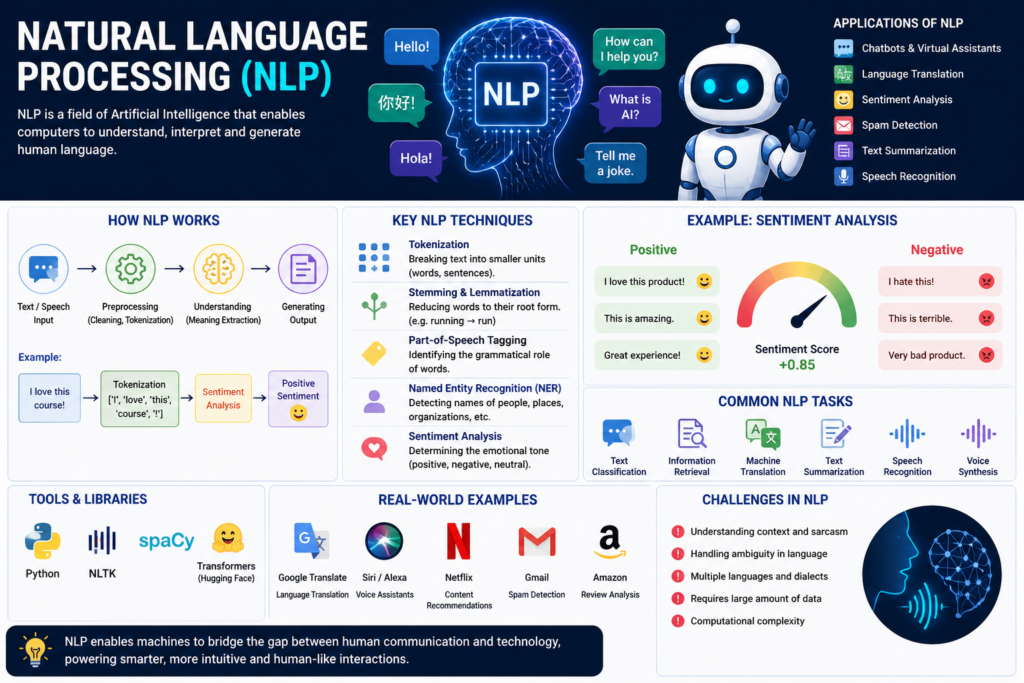
Natural Language Processing (NLP) is a field of Artificial Intelligence that enables computers to understand, interpret, and generate human language (text and speech).
How NLP Works
NLP combines:
- Linguistics (language rules)
- Machine Learning (learning from data)
Basic Steps:
- Text input (sentence or speech)
- Processing (cleaning, tokenization)
- Understanding meaning
- Generating output
Computer vision (CV)
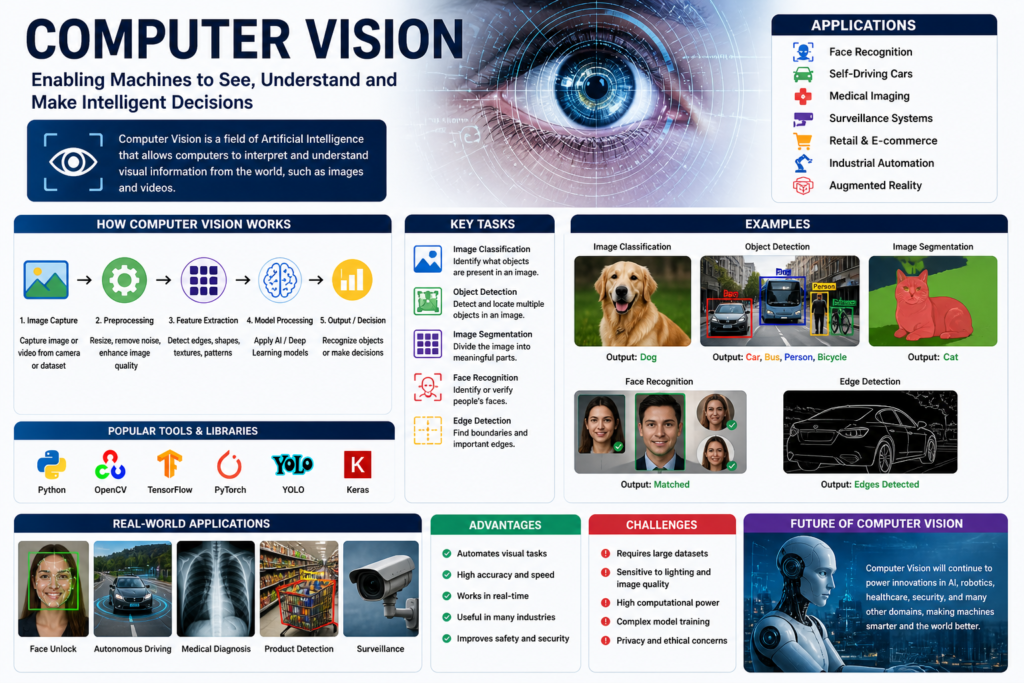
Computer Vision is a field of Artificial Intelligence that enables computers to see, understand, and interpret images and videos just like humans.
How Computer Vision Works
Computer Vision follows these steps:
- Image Capture – from camera or dataset
- Preprocessing – cleaning and enhancing image
- Feature Extraction – identifying patterns (edges, shapes)
- Model Processing – using AI algorithms
- Output – recognition or decision
Key Techniques
- Image Classification → identifying objects
- Object Detection → locating objects in an image
- Image Segmentation → dividing image into parts
- Face Recognition → identifying people
- Edge Detection → finding boundaries
Applications of Computer Vision
- 📸 Face recognition (mobile unlock)
- 🚗 Self-driving cars
- 🏥 Medical imaging (X-rays, scans)
- 🛍️ Retail (product detection)
- 🛡️ Security & surveillance
Reinforcement Learning
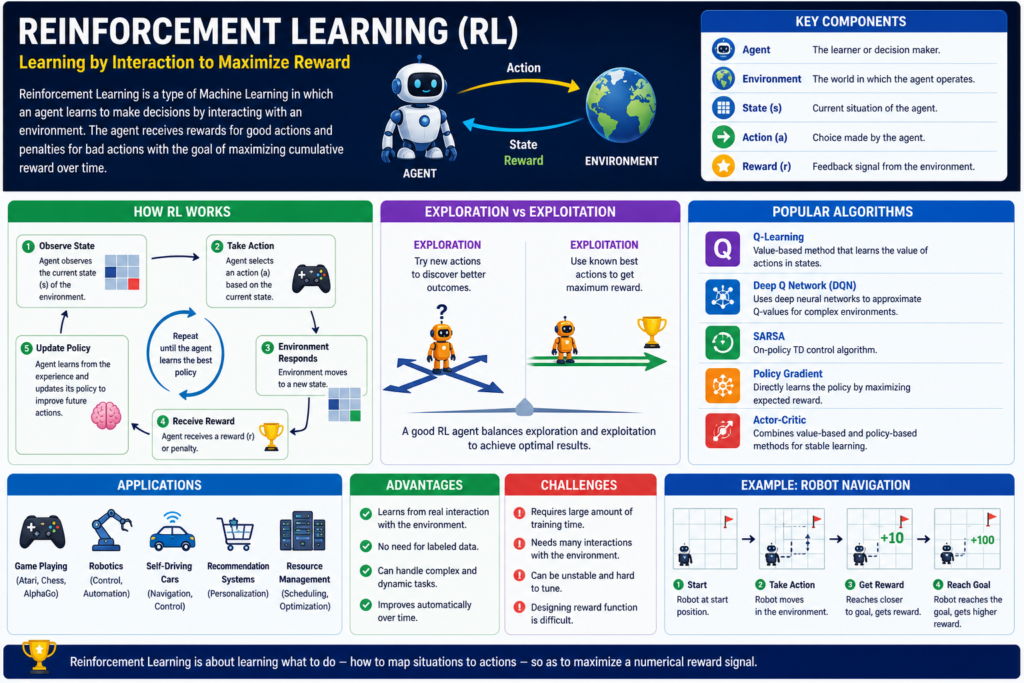
Reinforcement Learning (RL) is a type of Machine Learning in which an agent learns how to make decisions by interacting with an environment. Instead of learning from labeled data, the agent improves its performance through trial and error. The main goal of reinforcement learning is to maximize the total reward over time by choosing the best possible actions in different situations.
In reinforcement learning, there are several important components. The agent is the learner or decision-maker, while the environment is everything the agent interacts with. A state represents the current situation of the agent, and an action is what the agent chooses to do. After taking an action, the agent receives a reward, which tells it whether the action was good or bad. This feedback helps the agent learn and improve.
The working process of reinforcement learning is continuous and dynamic. The agent observes the current state, takes an action, and then receives feedback from the environment in the form of rewards or penalties. Based on this feedback, the agent updates its knowledge and adjusts its future decisions. Over time, the agent learns the best strategy, known as a policy, to achieve maximum rewards.
A key concept in reinforcement learning is the balance between exploration and exploitation. Exploration means trying new actions to discover better outcomes, while exploitation means using the best-known actions to gain rewards. A good reinforcement learning system maintains a balance between these two to achieve optimal performance.
There are different types of reinforcement learning methods. In model-free learning, the agent learns directly from experience without understanding the environment’s structure. In model-based learning, the agent builds a model of the environment and uses it to plan actions. Popular algorithms in reinforcement learning include Q-Learning, SARSA, Deep Q Networks (DQN), and Policy Gradient methods.
Reinforcement learning is widely used in real-world applications. It is applied in game playing (like chess and video games), robotics, self-driving cars, recommendation systems, and resource management. These applications require systems to make decisions in complex and changing environments.
Reinforcement learning has many advantages. It does not require labeled data, it can learn from real-time interaction, and it continuously improves its performance. However, it also has challenges, such as requiring a large amount of training time, needing many interactions with the environment, and designing an effective reward system.
In conclusion, reinforcement learning is a powerful approach that allows machines to learn from experience and make intelligent decisions. It plays a major role in advanced AI systems and continues to grow in importance as technology evolves.
MLOps & Deployment
MLOps (Machine Learning Operations) is a set of practices that combines machine learning, software engineering, and DevOps to manage the complete lifecycle of machine learning models. It focuses on automating and streamlining the process of building, training, testing, deploying, and maintaining AI models in real-world environments.
MLOps helps organizations move machine learning models from development to production efficiently. It ensures that models are reliable, scalable, and easy to update. By using MLOps practices, teams can collaborate better, reduce errors, and deliver AI solutions faster.
The MLOps lifecycle includes several stages. It begins with data collection and preparation, followed by model development and training. After training, the model is evaluated and validated to ensure accuracy. Once approved, the model is deployed into a production environment where it can be used by real users or applications.
Deployment is the process of making a trained machine learning model available for use. This can be done through web applications, mobile apps, or APIs. For example, a recommendation system on a shopping website or a chatbot in a customer service app uses deployed machine learning models.
There are different types of deployment methods. In batch deployment, predictions are made on large datasets at scheduled intervals. In real-time deployment, the model provides instant predictions when users interact with the system. Edge deployment allows models to run on devices like smartphones or IoT devices without relying on cloud servers.
MLOps also involves monitoring and maintenance of models after deployment. Over time, model performance may decrease due to changes in data, known as data drift. MLOps ensures continuous monitoring, retraining, and updating of models to maintain accuracy and performance.
Popular tools used in MLOps include version control systems, CI/CD pipelines, containerization tools like Docker, orchestration tools like Kubernetes, and cloud platforms such as AWS, Azure, and Google Cloud. These tools help automate workflows and manage models efficiently.
MLOps provides several advantages. It improves efficiency, ensures faster deployment, enhances collaboration between teams, and maintains model reliability. However, it also has challenges such as complexity, need for proper infrastructure, and requirement of skilled professionals.
In conclusion, MLOps and deployment play a crucial role in bringing machine learning models into real-world use. They ensure that AI systems are not only built effectively but also deployed, maintained, and scaled successfully in production environments.
Responsible AI
Responsible AI refers to the development and use of artificial intelligence systems in a way that is ethical, fair, transparent, and accountable. It ensures that AI technologies are designed to benefit society while minimizing harm, bias, and misuse. As AI becomes more powerful and widely used, responsible practices are essential to build trust and protect users.
Accountability is also a critical aspect of Responsible AI. Organizations and developers must take responsibility for the outcomes of their AI systems. If an AI system causes harm or makes incorrect decisions, there should be clear processes to address and correct these issues.
Privacy and security are essential in Responsible AI. AI systems often rely on large amounts of data, including personal information. It is important to protect user data, follow data protection regulations, and ensure that sensitive information is not misused or exposed.Responsible AI is about building and using AI systems in a way that is ethical, fair, and beneficial for society. By following responsible practices, we can ensure that AI technologies are trustworthy, safe, and aligned with human values.
AI Capstone Project

Information
An AI Capstone Project is a final, comprehensive project that allows students to apply all the knowledge and skills they have learned in Artificial Intelligence and Machine Learning. It is typically completed at the end of a course or diploma program and focuses on solving real-world problems using AI techniques.
The main purpose of a capstone project is to provide hands-on experience. Students work on practical tasks such as data collection, data preprocessing, model building, evaluation, and deployment. This helps them understand the complete lifecycle of an AI project, from problem identification to final solution.
In an AI capstone project, students usually select a specific problem or domain, such as healthcare, finance, education, or e-commerce. They then apply suitable machine learning or deep learning models to analyze data and generate meaningful insights or predictions. For example, projects can include building a recommendation system, developing a chatbot, creating an image recognition model, or designing a fraud detection system.
Capstone projects often involve the use of popular tools and technologies such as Python, TensorFlow, Scikit-learn, and data visualization libraries. Students may also use cloud platforms and deployment tools to make their models accessible as real applications.
Another important aspect of a capstone project is teamwork and presentation. Students may work individually or in groups and are required to present their project, explain their approach, and demonstrate their results. This improves communication and problem-solving skills, which are essential in the industry.
AI capstone projects are highly valuable for building a strong portfolio. They showcase practical skills to employers and increase job opportunities in roles such as AI Engineer, Data Scientist, and Machine Learning Engineer.
Who This Course is For
- Students
- Beginners in coding
- Working professionals
- Entrepreneurs
Professional Diploma in AI – Duration & Fees
| Course Type | Duration | Fees |
|---|---|---|
| Short-term Diploma | 6–9 months | ₹20K – ₹80K |
| Professional Diploma | 6–12 months | ₹50K – ₹2L |
| Advanced Diploma | 6–12 months | ₹45K – ₹1L+ |
| University Diploma | 2–3 years | ₹1L – ₹3L+ |